
RF and Speed
Low-rate wireless can be beneficial in the following situations:
- For Noisy Environments: Environments with limited Signal-to-Noise Ratio (SNR) necessitate the use of less complex, and therefore slower, modulation methods.
- For Long-Range Communications: Longer distances result in weaker signals at the receivers and may require slower modulation methods.
- For Limited Frequency Bandwidth Available: Narrower channels have fewer carriers and require slower data rates, even with more complex modulation
RF data rates are impacted by:
- Modulation.
- Coding.
- Channel Bandwidth.
- SNR/SNIR.
- Spatial Streams.
RF and Range
Range of a wireless connections is a reference to the physical distance over which a connection may be maintained. Three primary factor impact the maximum capable range un a wireless link.
- Output Power.
- Frequency Bands.
- Antennas.
802.11 Frequency Bands
| Standard | PHY Name | Maximum Data Rate | Support Band | Max Channel Width |
|---|---|---|---|---|
| 802.11-1997 | DSSS | 2 Mbps | 2.4 GHz | 22 MHz |
| 802.11b | HR/DSS | 11 Mbps | 2.4 GHz | 22 MHz |
| 802.11a | OFDM | 54 Mbps | 5 GHz | 20 MHz |
| 802.11g | ERP | 54 Mbps | 2.4 GHz | 20 MHz |
| 802.11n | HT | 600 Mbps | 2.4 GHz / 5 GHz | 20 MHz |
| 802.ah | S1G | 350 Mbps | Sub-1 Ghz | 16 MHz |
| 802.af | TVHT | 570 Mbps | Television White Spaces | 32 MHz |
| 802.11ad | DMG (Directional Multi Gigabit) | 7 Gbps | 60 GHz | |
| 802.11ac | VHT | 7 Gbps | 5 GHz | 160 MHz |
| 802.11ax | HE | 9.6 Gbps | 2.4 GHz / 5 GHz | 160 MHz |
8022.11 networks use frequency space ranging from 700 MHz to 66 GHz for 802.11-2020. The five principal bands are: Sub-1GHz, 2.4 GHz, 5 GHz, 6 GHz and 60 GHz.
2.4 GHz Channels
The 2.4 GHz band ranges from 2.400 to 2.500 GHz; however, 802.11 devices use the range from 2.401 GHz to 2.495 GHz when all 14 channels are supported. North America supports only channels 1 through 11. It is important to note that 1, 2, 5.5, and 11 Mbps transmissions use 22 MHz channels, while all other data rates in the 2.4 GHz range use 20 MHz channels.
5 GHz Channels
Channels 52-144 requires DFS (802.11h) in many regulatory domains. Older clients are very unlikely to support channels 120-128 as they were disallowed for Terminal Doppler Weather Radar (TDWR)
Wi-Fi 6E Channels
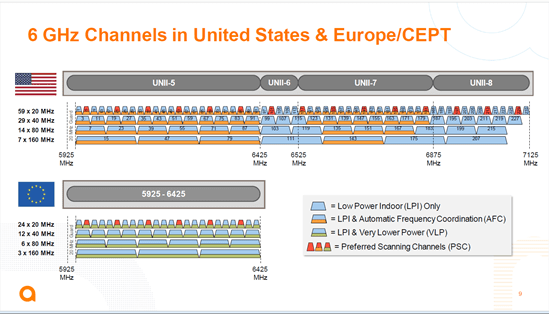
There are 59 20 MHz Channels.
802.15.4
The 802.15.4 standard is designed for Low-Rate Wireless Networks (LR-WPANs). This standard defines a low-rate wireless personal area network and serves as the basis for several well-known protocols.
Zigbee and 6LoWPAN are among the most well-known protocols based on the 802.15.4 standard. The most commonly used frequency bands for these networks are 868 MHz, 915 MHz, and 2.4 GHz. Consequently, the supported modulation methods include Direct Sequence Spread Spectrum (DSSS) and Offset Quadrature Phase Shift Keying (O-QPSK)
.
| Modulation | Band | Data Rate |
|---|---|---|
| O-QPSk | 2.4 GHz | 250 kbps |
| DSSS | 868 MHz | 20 kbps |
| DSSS | 910 MHz | 40 kbps |
802.15.4 Architecture
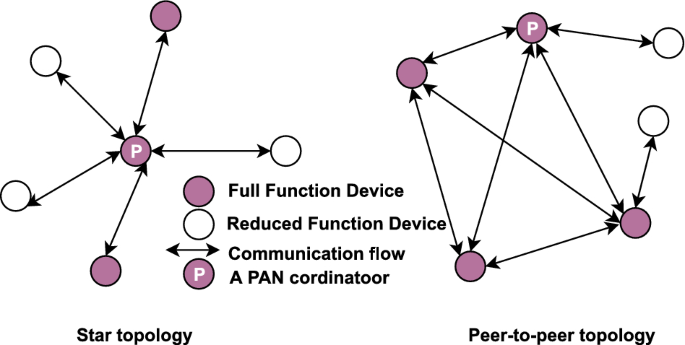
An 802.15.4 network can take the form of either a star topology or a peer-to-peer topology network. In this network, two basic device types participate: Full Function Device (FFD) and Reduced Function Device (RFD). An FFD has the capability to become a Personal Area Network (PAN) coordinator, while an RFD cannot. RFD units use the network for communications but do not control the network in any way. If the PAN coordinator leaves the network, another FFD unit can take over PAN coordinator functions.
The PAN coordinator initiates the network, and in a star topology, all communications go through it. In a star topology, the PAN coordinator would usually be mains-powered. Devices not acting as the PAN coordinator may be battery-powered or mains-powered as well.
In peer-to-peer topology, devices can communicate directly witch each other. Generally the first devices communicating on the channel becomes the PAN coordinator, but if this device leave the network, another FFD may be select to the role.
Cluster tree network are also supported . Such networks are built by interconnections among multiple PANs. The cluster tree is built when the PAN coordinator in the first cluster instructs another FFD to become the PAN coordinator of a new cluster adjacent to the existing one.
Z-Wave Architecture
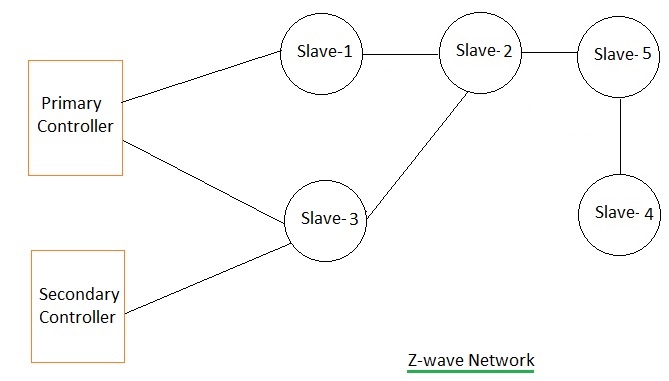
Z-Wave is a highly popular IoT network solution in the smart home market, and it also includes features that make it useful in large networks and implementations. All Z-Wave products can connect to each other, provided they are within range. However, specific nodes fulfill the role of controllers. These controllers enable other nodes to join the mesh network, a process known as inclusion. A single Z-Wave mesh can accommodate up to 232 nodes, but multiple meshes can be interconnected through hubs or gateways. The primary controller is sometimes referred to as a hub or gateway, and a secondary controller may exist to allow remote nodes to participate in the mesh. Nodes can take up to four hops to reach the controller.
Bluetooth
In its initial stages, Bluetooth primarily served as a solution for peripheral connectivity, facilitating the connection of devices such as mice, keyboards, audio headsets, headphones, speakers, and similar peripherals. Over the years, significant enhancements have been implemented in Bluetooth Low Energy (BLE), transforming it into an IoT connectivity solution. It now has the capability to establish links that, in certain instances, can cover distances of up to 2 kilometers..
- Bluetooth Low Energy (BLE), initially introduced in 2010 with Bluetooth 4, laid the groundwork for technologies like beacons. With the advent of Bluetooth 5, BLE was further improved, offering twice the speed and four times the range compared to its earlier version. Prior to Bluetooth 5, the maximum speed was 1 Mbps, but version 5 introduced a 2 Mbps PHY (Physical Layer) as well.
- Beacons: BLE beacons have been an integral part of Bluetooth for nearly a decade and serve as the functional foundation for technologies such as iBeacons and other beaconing systems, primarily utilized for location services. This location method can achieve accuracy between 1 and 2 meters.
- Direction Findings: New in Bluetooth 5.1 is the use of Angle of Arrival (AoA) and Angle of Departure (AoD) for enhanced accuracy in location tracking. Bluetooth 5.1 devices can now be located within 10cm with an accuracy rate of 86%.
- Mesh:Bluetooth mesh implements a many-to-may devices network that can scale from tens to thousands os devices communicating. It uses BLE for communication and this is why field devices may be upgrade to bluetooth mesh if they have sufficient processing power an memory.
Bluetooth support three topologies today:
– Point-to-Point: Is the oldest solutions in bluetooth and is what is used for peripheral connectivity.
– Broadcast: Is part od BLE and provides beaconing and advertisement features for applications that provide information to user devices and notifications as well.
– Mesh:Modern game-changer and may well introduce new opportunities for entrance in to the IoT Market.
LoRa (Long Range) /LoRaWAN
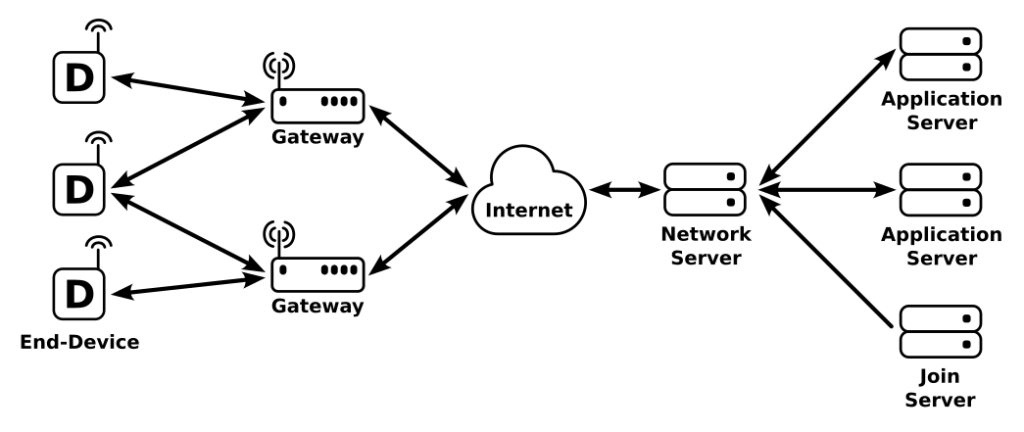
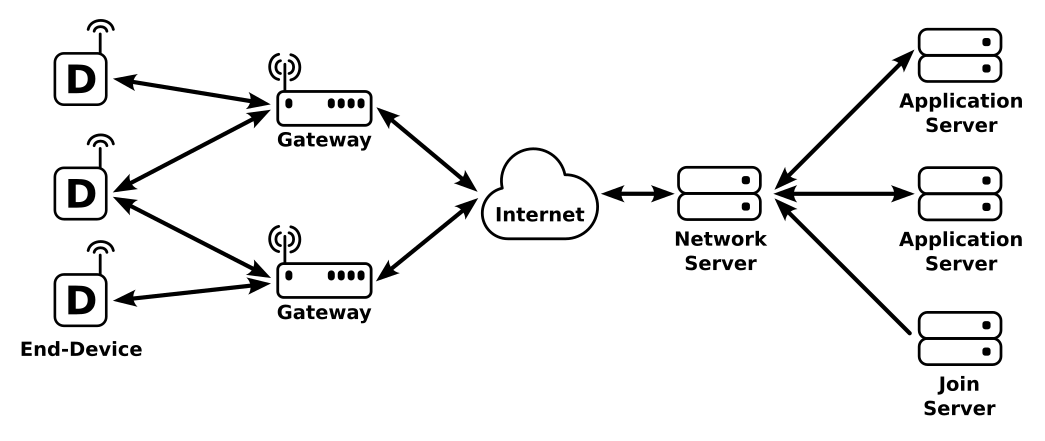
LoRa and LoRaWAN are not necessarily synonymous. LoRa serves as the foundation upon which LoRaWAN is constructed. LoRa facilitates machine-to-machine communications, while LoRaWAN establishes the broader network. LoRaWAN falls under the Low-Power WAN category, similar to NB-IoT and LTE-M. The LoRa Alliance advocates for and supports the LoRaWAN open standard. A LoRaWAN network consists of gateways communicating via IP connections with non-LoRa networks. They also communicate through single-hop LoRa or FSK communications with end devices. All communications between end devices use LoRa (with CSS) on the radio channel until they reach a gateway, which may involve multiple single hops. The communications are then encapsulated as IP and sent to the server or cloud managing the devices.
LoRa WAN functionality is defined in classes:
- Class A: devices support bi-directional communications, where an uplink transmission from an end device is always followed by short downlink receive windows. It’s important to note that Class A devices cannot receive communications from the network (downlink) except for the time during the receive windows immediately after an uplink transmission. Despite this limitation, Class A devices are known for consuming the least power.
- Class B: These devices provide more receive windows. The class A receive process is still supported, but class B device open additional receive windows at scheduled time.
- Class C: These devices have an open windows. They are unable to receive when transmitting, but they can receive at any time. These device consume the most power.
In summary, LoRa offers long-range connectivity, a potential 10-20 years battery lifetime and minimal infrastructure costs. You can establish a base station ini an area and many devices in a radius about 5-7 kilometers or more, can connect to the base station in many cases. 10 Mbps connection can server several dozen end-devices easily.
LoRa/LoRaWAN Architecture
LoRa operates as a peer-to-peer protocol, allowing two LoRa devices to communicate directly without the need for a LoRaWAN gateway.
Additionally, LoRa serves as the protocol for communication between LoRa devices and LoRaWAN gateways. These gateways play a crucial role in providing access to the external world. Both the gateways and the LoRa devices are managed by a LoRaWAN server, which can be situated on the broader network, within the LoRaWAN gateway, or in the cloud
ZigBee
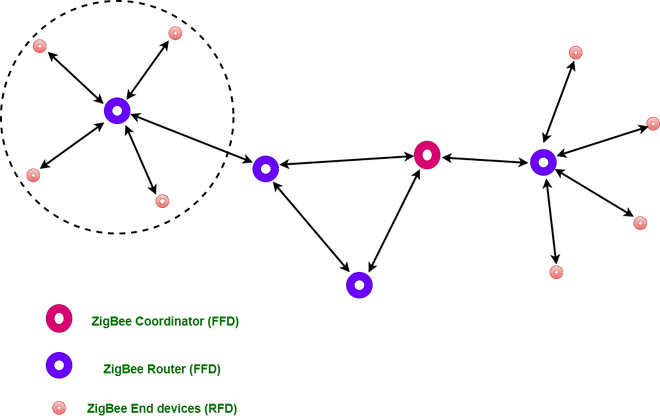
In a star topology, the Zigbee network is overseen by a single device known as the Zigbee coordinator. The Zigbee coordinator plays a crucial role in initiating and maintaining the devices within the network. All other devices, classified as end devices, communicate directly with the Zigbee coordinator.
In mesh and tree topologies, the Zigbee coordinator takes on the responsibility of initiating the network and selecting key network parameters. However, the network can be expanded through the inclusion of Zigbee routers. Zigbee operates across multiple frequency bands, including 868 MHz, 915 MHz, and 2.4 GHz. Positioned within the short-range, low power, and low rate categories, Zigbee has an indoor range of approximately 75 to 100 meters and an outdoor range of up to 300 meters.
ZigBee Channels
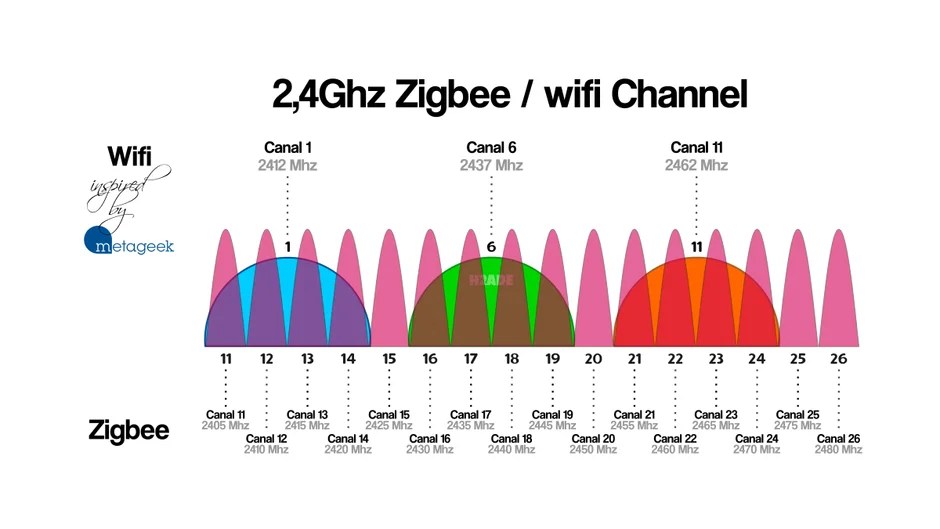
Zigbee networks, operating in 2.4 GHz, use a total of 16 channels that are 22 MHz wide and separated by 5 MHz. By using Zigbee channels 15, 20, 25 and 26 you introduce least interference with Wi-Fi Networks.
Narrowband IoT (NB-IoT) and Long Term Evolution (LTE-M)
LTE-M was the inaugural cellular network protocol specifically crafted for IoT applications, predating NB-IoT. LTE-M, classified as a Low-Power Wide-Area Network (LPWAN) technology, is well-suited for IoT use cases, delivering extended coverage and supporting a battery lifetime of up to 10 years. In comparison to NB-IoT, LTE-M boasts a broader bandwidth and facilitates higher data rates.
On the other hand, NB-IoT, despite supporting lower data rates, excels in offering an extended battery life exceeding 10 years. This is achieved through its utilization of narrower bandwidth and lower data rate consumption.

 Our techie journey
Deja un comentario