
Below you will find the key ideas from Chapter 8 of CWISA-102.
WSN Applications
- Home and Office.
- Industrial.
- Health Care.
- Agriculture.
- Transportation.
- Environmental.
Measurement Instruments
A measurement instrument is a component capable of detecting variations in a process or measurable value. For instance, it can measure pressure in a liquid flow process, air pressure in tires, and more. Traditional measurement instruments did use sensors, but they were not linked to any remote monitoring solution. Instead, they were connected to gauges and eventually to electrical displays (such as LEDs or digital displays). Subsequently, they were linked via wires to remote display consoles, and now they can connect through wireless links for remote monitoring and control.


For such localized measurement instruments, four primary components provide their functionality.
- Sensor: The element that detects states related to some physical property.
- Amplifier: The element that increase the values detected, as changes in state can be very small so that they are useful to humans.
- Conditioner: The element that ensures proper structure in the signal to all for display.
- Display: The pressure or electrical gauge, LED, LCD display of the metric at the moment.
Finally, these traditional sensors were integrated with communication relays, enabling the detected states to be transmitted to a control center or control room for centralized monitoring. Initially, these communications were transmitted across proprietary wired links, and over time, they transitioned to use Ethernet links. Now, they have evolved to include wireless connections, giving rise to modern Wireless Sensor Networks (WSN)..
Sensors Types and Actuators
- Mobile Sensors: Special sensors designed to be placed on mobile units enable tracking and monitoring. Being wireless, as long as these mobile units remain within the range of the overall Wireless Sensor Network (WSN), they can continually transmit metrics.
- Remote Sensors: Wireless sensors equipped with batteries and/or energy harvesting mechanisms can be deployed in challenging locations where wired cabling is impractical.
- In-Ground Sensors: As long as they are not too deep wireless sensors can be placed beneath the Earth’s surface for monitoring a reporting. There are sometimes called “Wireless Underground Sensor Networks” (WUSN).
At 2.4 GHz, a distance of less than .5 meters is usually required for effective communications.
At 400-500 MHz a rang of 1.5 meters is often acceptable.
Depending of the soil a sub-1 GHz signal will be attenuate by 60-120 dB per meter. - In-Structure sensor:These are sensors embedded in structure. They may be embedded with cable runs energy harvesting, or they may be embedded in accesible cavities so that batteries can be replaced every 3 or more years as needed.
Actuator can aim antennas, reposition cameras or even refocus or move the sensors themself. In some implementations, the sensor will exist as one device and the actuator as another. In other implementation, the sensor and actuator will be integrated into a single device.
Five Important WSN Characteristics
- Small, Medium, Large and Very Large WSN: The size of the WSN varies depending on several factors such as sensors characteristics, the return on investment and user requirements.
- Homogeneous versus Heterogenous: A WSN is homogeneous if all sensors of the network have the same capabilities. A heterogeneous WSN consists of sensor with different capabilities.
- Stationary, Mobile and Hybrid WSN:A stationary WSN is a network consisting of stationary sensor nodes that cannot move once deployed. With the advances in mobile devices, some sensor are able to move by your own.
- Flat vs Hierarchical WSN:In flat WSNs, all the sensor nodes are assumed to be homogeneous and play the same role. However, in hierarcherical WSNs a sensor node can bee dedicated to a particular special functions.
- Single Hop vs Multi Hop: In a single hop WSN sensor nodes transmit their data directly too the sink. In a multiple hop WSN multiple relaying sensor nodes exist between sensors and sinks.
Cloud Controller WSN
The more processing power required, the more likely to perform it in the cloud.
Hierarchical and Mesh Architecture
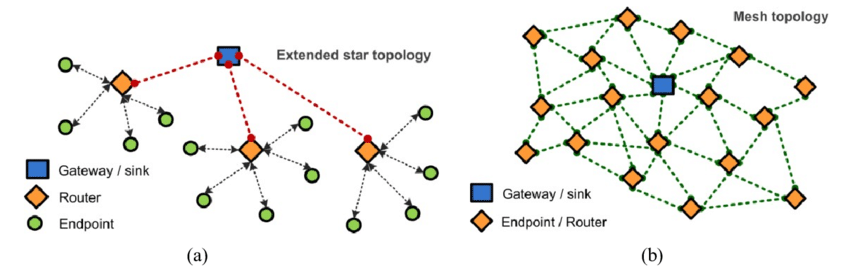
In a hierarchical architecture, the wireless sensors connect to a specific node that is either the gateway onto the network at large or is router providing connectivity to the gateway.
A simple hierarchical architecture connects all sensors to a single gateway and is sufficient for WSN in smaller facilities or small-scale outdoor deployment.

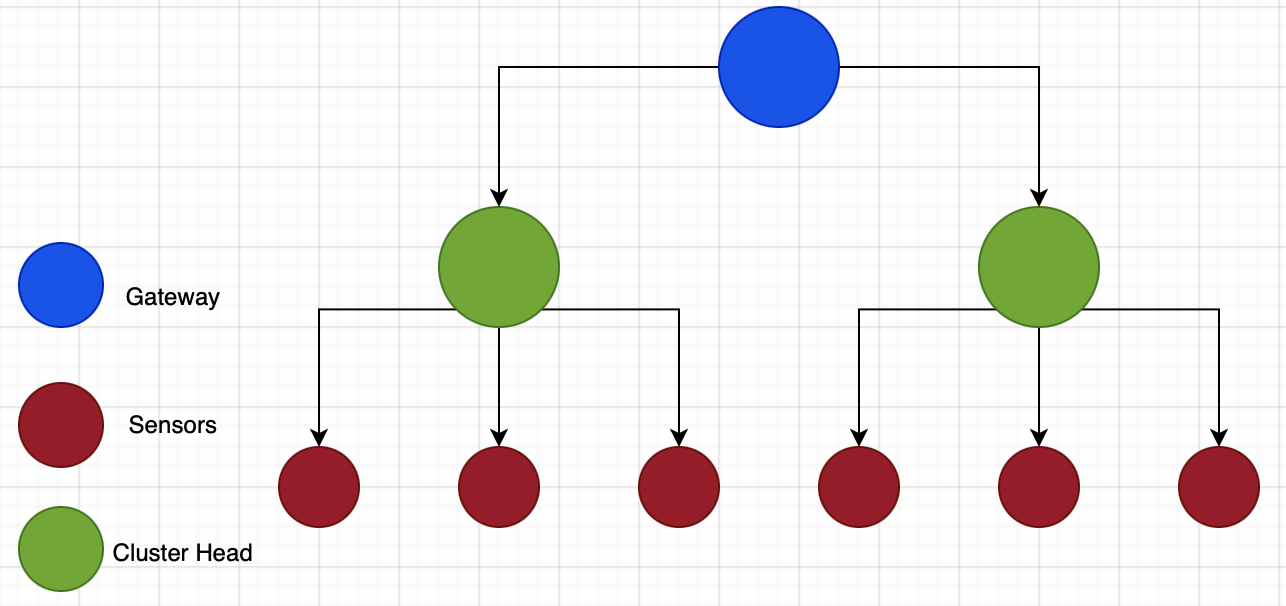
A complex hierarchical architecture may use cluster with all sensor un a cluster connecting to a cluster head, which is connected to the Gateway. Other terms for gateways include base station, coordinator, hub and controller.
Unlike the hierarchical architecture, in a mesh architecture, multiple nodes can use multiple routes to reach the gateway. Mesh architecture support full and partial implementation
Planning a WSN (Requirements)
- What kind of sensors are required?
- Does a single vendor provide all of these sensors?
- If multiple vendors must be used, are sensors available that interoperate directly using the same technology.
- Does the solution require a pre-built cloud services for monitoring and control or will local server be utilized.
- It is a single-site deployment or multisite deployment.?
- What is the size of the area requiring sensor connectivity?
- Will power be available at the sensor locations or should they be battery powered.
Planning a WSN (Constraints)
- What are wireless technologies already in use in what frequency bands do they operate?
- Are specific regulations, guidelines, or policies imposed upon you?
- Does existing sensor have to be integrated with the new WSN?
- Does the WSN need to support integrations with SCADA or DCS solutions already in place?
Supervisory Control and Data Acquisition and Distributed Control System are existing OT solutions for monitoring, operating, and controlling many systems in industrial an other organization.

 Our techie journey
Deja un comentario